I sit in the back of a police cruiser as it makes its way out of Atlanta at a pace that is somehow equally comforting and agonizingly terrifying; I have done something terrible and I am being ferried to my punishment. I watch the landscape outside pass by with the longing of a man who wants only to travel backwards, occasionally looking up to make eye contact with the man behind the wheel as he does his best to make smalltalk to pass the time. A job I would not envy the man, but he’s old and has obviously been wearing the star on his shirt far longer than I’ve been on the opposite side of it and he manages to illicit the truth from me about the events that have led me to this moment. And so it goes for the next few minutes; questions followed slowly by answers I struggle with.
After a moment, I begin to notice something isn’t right. It starts with a few police cars passing, headed back toward the city at a decent clip, sirens blazing. This alone would not have been worth the small amount of thought I have left as a free man. But those sirens are soon followed by more, then more still; the vehicles from which the sirens blare growing in both size and speed. Then, as the sherif stares at me through the mirror, awaiting my response to his latest question, I look up to see…something…in the road! I have just enough time to yell, “Oh, shit!”
Then the world screams and tilts violently sideways…
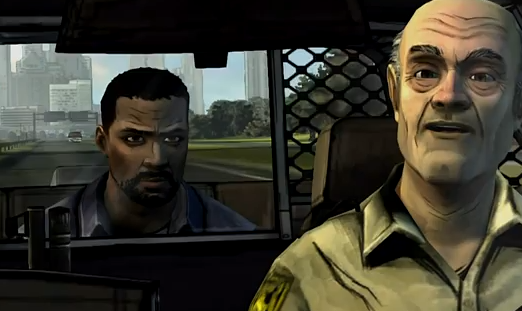
This is how the opening moments of Telltale Games’ The Walking Dead: Episode One play out. It is immediately apparent to anyone who is familiar with the comics in which this whole crazy zombie-filled phenomenon first took hold of the world thanks to the minds of Robert Kirkman, Tony Moore, and Charlie Aldrad that it is those black-and-white images and the world they paint from which the team at Telltale has pulled their inspiration. Don’t get me wrong, I am a big fan of the show–slow second season and all–but my love for Kirkman’s original comic knows no bounds, so it delights me to no end that the game’s world is one and the same. Not to mention the gorgeous art direction, but we’ll get to that. For now, let’s get the “bad” stuff out of the way.
In my experience, no game is without its personal faults and The Walking Dead is without exception. However, my only real complaint that goes beyond a personal preference (no camera inversion, Telltale? Really?) would have to be the movement controls. Whenever you’re moving freely about the environment there’s a slight disconnect between your controller input and the character’s movements which makes it so that Lee seems to float around more than walk. This often results in you getting stuck on random bits of environment, though, I’d be wrong to say that this comes anywhere close to ruining the game in that the only time you’re moving freely is during the traditional “exploration scenes” that make up the brunt of most adventure games.
This leads me to my next point: The Walking Dead is just that, an adventure game. If you’re not familiar with the genre–made famous in my generation by games like Monkey Island and Grim Fandango or the later Longest Journey and Indigo Prophecy—then you will be in for something quite different than the usual action-filled games you’re used to. That said, anyone looking for a game in which your goal is to wrack up the head-exploding shotgun kills while wading ball-deep through a horde of hungry undead, this is not your game. Telltale has opted, it seems, to lean heavily toward story-telling and setting up a sense of actually being in a zombie apocalypse rather than dropping you into a mall full of shambling undead with a lawnmower and chainsaw. And, to be honest, it’s this focus on character developement and story-driven decision-making that gives The Walking Dead that something I’ve been looking for in a zombie game. I’m hooked.
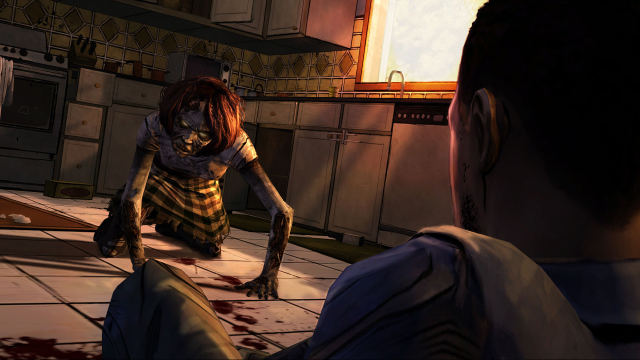
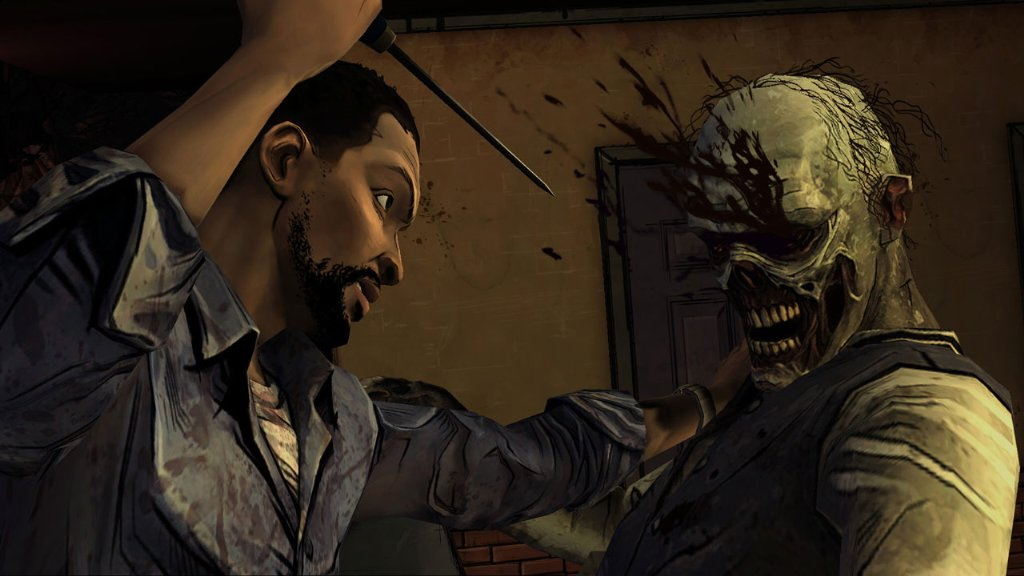
Of course, that’s not to say that The Walking Dead is without any violence at all. In fact, the game is surprisingly dripping in it. But it’s not violence for the sake of violence. It always drives the story forward and helps to build tension and fear. The first time you kill a zombie–albeit, unsurprisingly–it’s presented in a fashion that makes grounds you firmly in the reality of Lee’s situation and, depending on the kind of character you’ve made Lee to this point, kind of makes you feel bad. And that’s the thing I love about this game the most; every time you put weapon to flesh, it comes with a sense of sorrow and pain and the question of how necessary it was for you to do what you’ve done. There’s a moment toward the end of the episode that I found particularly jarring given my ability to relate to Lee and put myself in his shoes. Every drop of blood spilled from the moment I put my thumbs on the joysticks to the time the credits rolled was done so with grim determination and for the sake of keeping Clemmentine–the little girl who become your ward through a set of circumstances I won’t spoil–and the rest of the group I found myself with. But when that blood was spilled…whoooa boy was it ever!
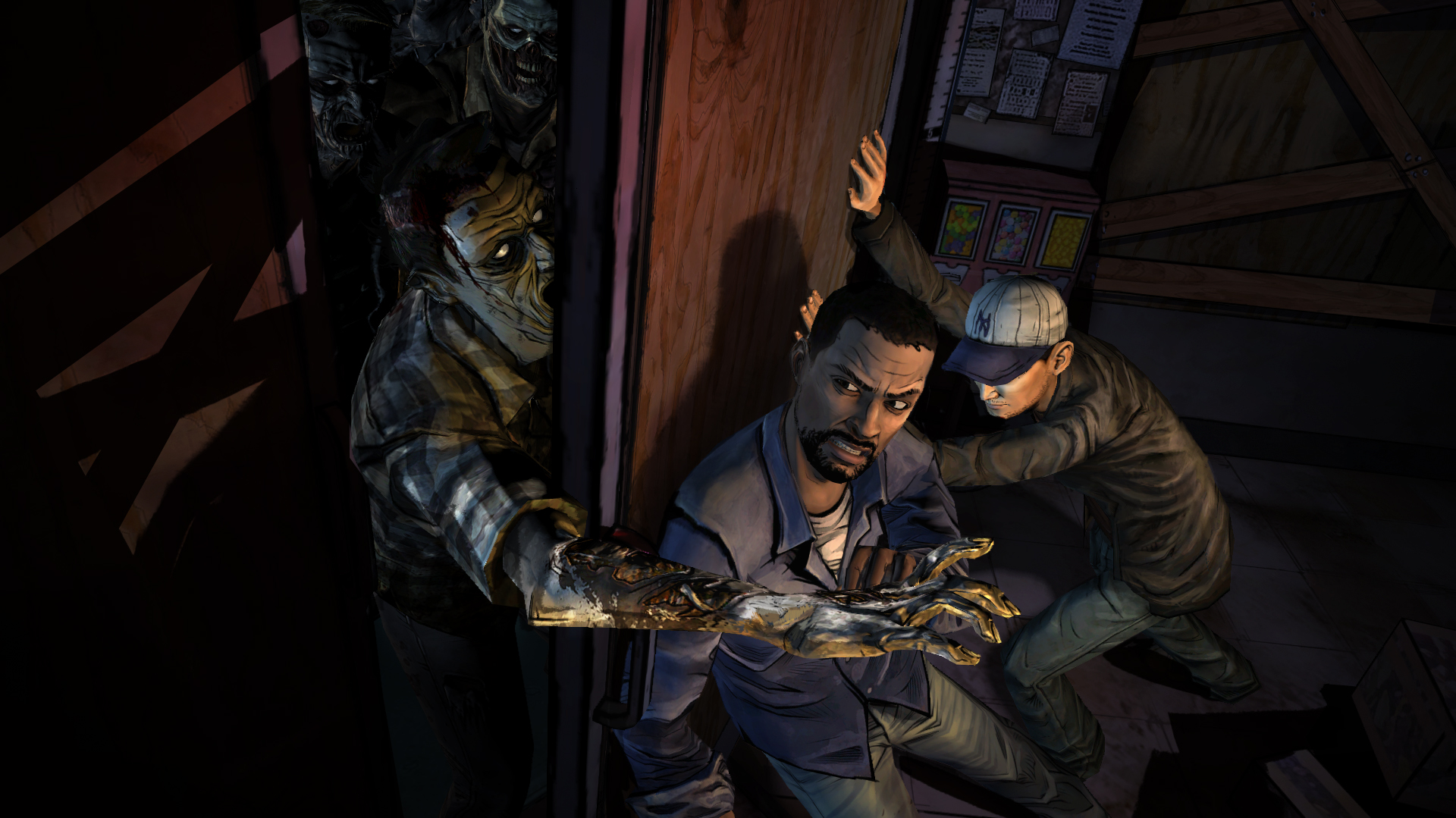
Now, as for the artstyle. Holy God, did Telltale nail this! At any given time you could pause the game, take a screencap, desaturate it, and easily use it for a panel in a Walking Dead spin-off comic. It’s rare to see cell-shading, comic-style artwork look good in motion–and there are some that have succeeded recently in this, to be sure–but Telltale seems to have taken the proverbial cake with this one. As an artist (yes, a mediocre one, I know) it is always great to see a game that has a focus making their world artistic. Everything looks hand-drawn and colored but moves with the solid weight we’ve come to expect from a realistically-rendered world. That is, if you don’t count Lee’s floaty feet. And, harking back to the violence mentioned above, while it is easy to be lulled into a sense of relative complacency about how the game looks like it’s been drawn and has a “kiddie” feel to it…you need to understand that Telltale has used that to its advantage and when you kill a zombie, there is nothing “kiddie” about it. All the violence in The Walking Dead is brutal and handled accordingly.
So, in short, I feel like TellTale–a company known for its episodic story-telling–has shambled into something truly amazing here. They have taken all the right pieces and fit them together into a game that I believe will take its rightful place at the head of the herd (a little Walking Dead reference there, eh?). Each episode is roughly $5 and, as far as I know, both the PC and PS3 versions offer a Season Pass which nets you a bit of savings on the overall cost. Xbox does not, at this time, offer such a deal. That’s okay…I’m a whore so I’ll pay for them all separately.
Till next time!
–Ray

